
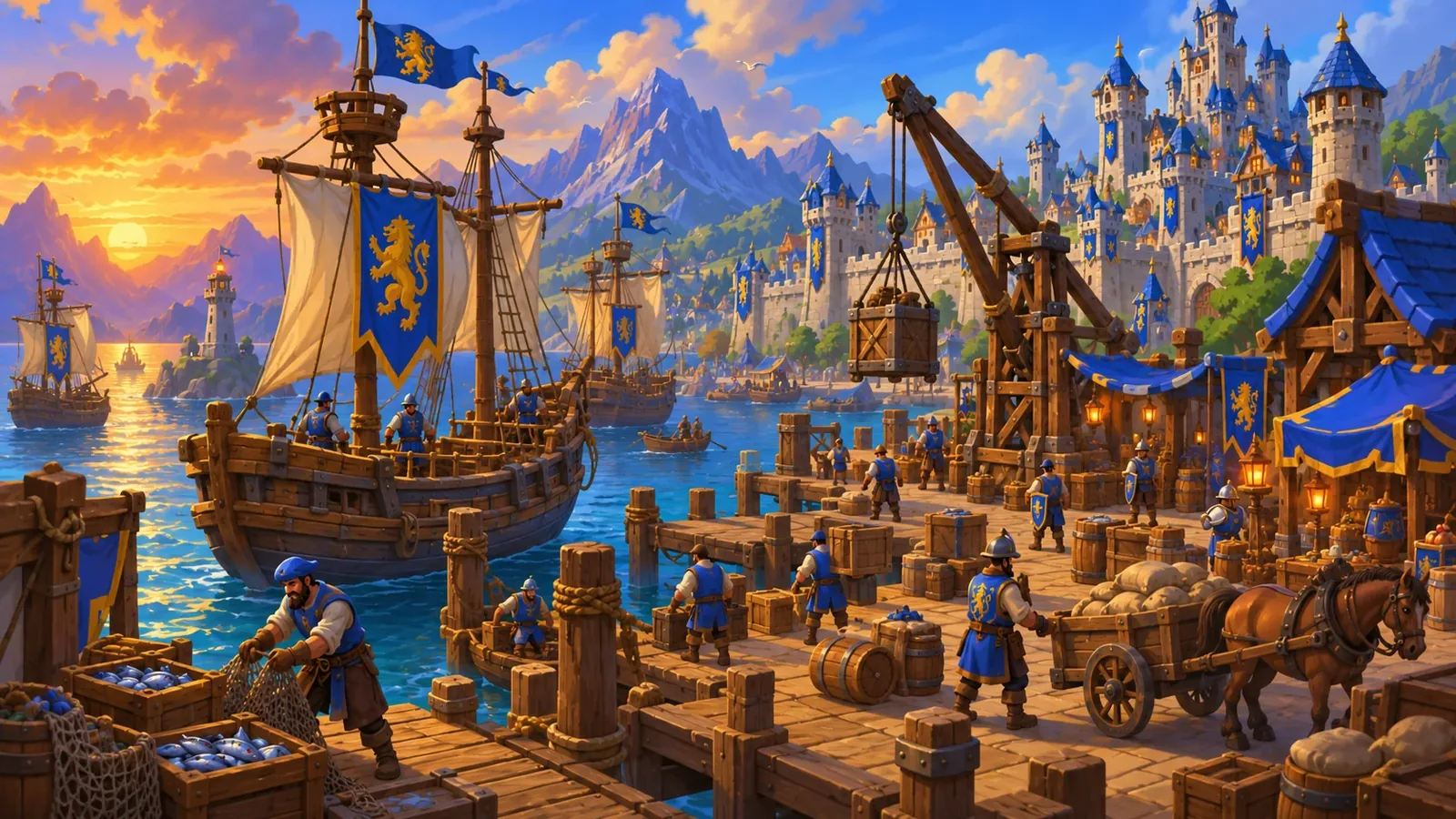
There is no crafting menu in Koria Vault that conjures a thing out of numbers. Every good in the game is made somewhere, by somebody, out of something that also had to be made — and the whole economy is one long argument about where you put your buildings.
Four chains, one shape
Timber is the one to learn first, because the others are shaped like it. A woodcutter fells a tree and carries logs to a sawpit. The sawpit turns logs into sawn timber. A hauler moves sawn timber to a store, and a builder takes it out again to raise a roof. Four roles, four buildings, and every one of them a place on the ground with a distance to everywhere else.
Stone is quarried, hauled and consumed by every serious building. Food runs field to mill to bakery, and rots if you are slow about it. Iron is the long one — ore and charcoal into a bloomery, bloom to a smith, four buildings deep before you have a blade.
The interesting part, for anyone who has built one of these before: iron required no new code. The chain is declared as data — what a unit gathers, what a building accepts and processes — and one file resolves the route by role. Adding a chain that needs a branch in the engine means the branch is the bug.
A full store is not a full stop
Every good has to go somewhere, and every store has a ceiling. When a store fills, the chain behind it backs up rather than leaking: the hauler stops delivering, the workshop stops consuming, and the gatherer keeps what they are carrying. Nothing is silently destroyed for want of a shelf.
That sounds like a small mercy and it is actually the load-bearing rule. A game that quietly deletes overflow teaches you to stop paying attention, because the punishment is invisible. A game that backs up shows you exactly where the blockage is — a queue of carts outside a full granary is a diagnosis you can read from the map.
Storage is four different buildings on purpose. A cellar keeps food cool and slows what would otherwise rot. A granary holds grain. A warehouse is the building that lets a holding stop worrying and start planning.
Distance is the rule everything hangs off
Your people walk. Your buildings do not. A villager goes to the tile, works it, and carries what they gathered back to a building you sited — so the ground decides everything and the siting decision is the game.
A granary four minutes from the field is a different economy from one built beside it. Not a worse economy — a different one, with different failure modes. This is why we price the whole chain with a tool that runs a holding forward against the real balance files and reports flow, backpressure and the cost of distance. If a change makes the numbers prettier and the distances meaningless, it does not ship.
Two limits, and they bite differently
Hands you fix in a moment: take somebody out of the bakery and put them in the sawpit. A building with nobody in it produces nothing and says so plainly, on the building, in a sentence rather than an icon.
Food takes hours to grow and hours to run out. It is the limiter you cannot fix this afternoon, which is what makes it the interesting one — a holding can fail in two directions and only one of them forgives you for arriving late.
Neither ever switches a building off. A shortfall scales output down. Switching off is punishing and opaque: you open the game and cannot tell what happened. Scaling down is legible — the number falls, and the cause is written where you are already looking.
The full roster runs to several hundred goods once the smithing and provisioning trees are in. The rule for every one of them is the same: it comes from somewhere, it goes somewhere, and both of those places are on the map.